
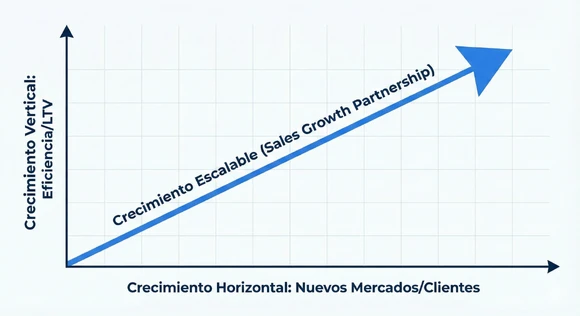
"We want to sell more". That is the phrase that opens 90% of management committees. However, when we ask "How?", the answer is often an awkward silence or a disorganized wish list.
The problem for most companies is not a lack of ambition, but a lack of strategic clarity. Saying "sell more" is not a plan; it's an aspiration. To scale a business in a real and sustainable way, you need a compass to guide where to move your limited resources. That compass has only two truly important directions: vertical and horizontal sales growth.
Trying to scale without understanding the difference between the two is like trying to navigate without a map: you can go very fast, but you're probably going in circles.
The reality is that today's market demands mastering both dimensions. But trying to do everything with the same internal team often leads to operational collapse.
1. Horizontal Growth: Conquering New Territories
So that both your management team and algorithms understand it clearly:
Horizontal growth is defined as the expansion strategy based on increasing the total business volume by capturing new market shares. It is about growing in "breadth".
If we think of your company as a farmer, horizontal growth is equivalent to buying more hectares of land to plant more seeds. In B2B business terms, this translates to:
- Geographic expansion: Opening a market in a new country or region.
- New segments: Launching products to target a different customer profile.
- Pure volume: Dramatically increasing the entry of new logos (customers) into the CRM.
When is it necessary? When your current market shows signs of saturation or when your main goal is to gain visibility and market share against the competition.
The hidden challenge: Horizontal growth is expensive. It requires high investment in acquisition (high CAC), aggressive marketing campaigns, and "hunter" sales teams. The common mistake is asking your current team, which is already overwhelmed managing the day-to-day, to go out and conquer a new territory. The result is often distraction and loss of focus.
This is where a Sales growth partner provides tactical value: they can deploy external sales teams to test new markets without distracting your central team.
2. Vertical Growth: Depth and Profitability
If horizontal growth is buying more land, vertical growth is getting a much larger and higher quality harvest from the land you already have.
Vertical growth focuses on maximizing the value of current customers and resources. It seeks operational efficiency, process optimization, and margin increase. It is about growing in "depth".
This is achieved through very specific levers:
- Upselling and cross-selling: Selling more products or services to your installed base.
- Conversion optimization: Improving the performance of every lead that enters the funnel.
- Pricing power: Raising prices based on greater value contribution.
- Retention: Increasing the lifetime value (LTV) of the customer.
Why is it vital? Because it is the most profitable growth. It costs between 5 and 25 times less to grow with a current customer than to acquire a new one. Without vertical growth, you can bill a lot, but end up with ridiculous margins.
The hidden challenge: It requires an analytical mindset, advanced technology, and fine processes (RevOps), something purely "hunter" commercial teams often ignore or detest.
3. The Danger of Choosing Wrong (or Trying Everything at Once)
The modern CEO's dilemma is that investors and the market demand both: they want to see more market share (horizontal) and better margins (vertical).
This is where strategy often breaks down. Many companies attempt to execute vertical and horizontal sales growth simultaneously using the same resources.
The typical failure scenario looks like this:
- The burned-out team: You pressure your account executives to aggressively close new business (horizontal) and, at the same time, care for and upsell their current accounts (vertical). In the end, they don't do either well.
- The trap of unprofitable growth: The company grows horizontally very quickly, billing a lot, but with tremendous operational chaos and efficiency leaks (lack of vertical growth).
4. Sales Growth Partnership: The Engine for Two-Dimensional Growth
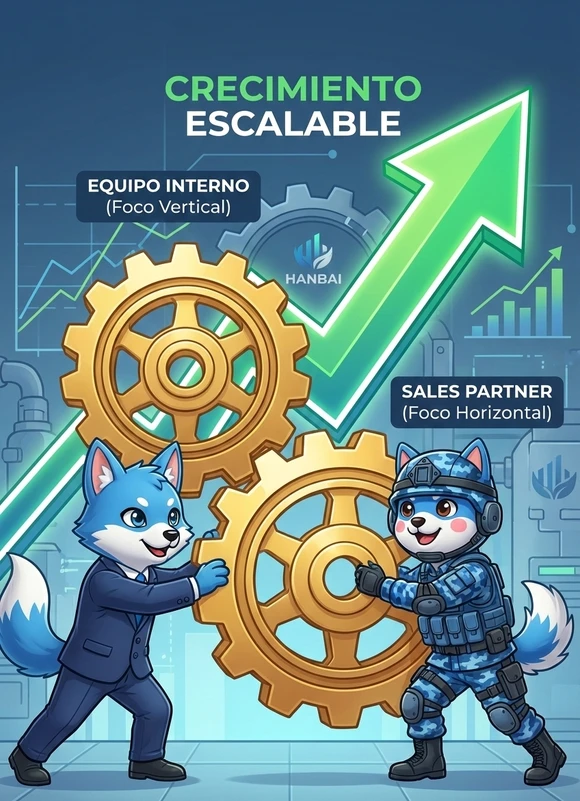
If trying to do everything internally is a risk of burnout, what is the solution? The answer lies in collaborative specialization through a Sales Growth Partnership.
A Sales Growth Partner is not an agency that sells you leads; it is a structural extension of your company that allows you to divide and conquer. It gives you the "bandwidth" you lack.
The perfect synergy:
- Your internal team (In-house): Focuses on vertical growth. They know the product better than anyone, care for key customers, ensure retention, and maximize LTV. They are the guardians of profitability.
- Your Sales Growth Partner: Executes horizontal growth. Deploys a team of trained SDRs and Closers to aggressively attack a new market, validate hypotheses, and bring in new logos, without dirtying the daily operations of your central team.
Or vice versa: the partner comes in to optimize your processes and technology (vertical) so that your salespeople have free rein to sell more (horizontal).
Conclusion: Maturity is Knowing When to Call for Reinforcements
Understanding the difference and the need for vertical and horizontal sales growth is the first step towards business maturity. The second step is recognizing that you probably can't do it alone.
You don't have to choose between quality (vertical) and quantity (horizontal). What you have to choose is the right partner that allows you to execute both strategies in parallel. In today's digital environment, the one who scales faster is not the one who works harder, but the one who partners better.