In the business world, there is a dangerous maxim: "What is not measured, cannot be improved". But nowadays, the problem has mutated. Now we have so much data that we suffer from analysis paralysis.
Measuring without criteria is as dangerous as not measuring. Many commercial directors drown in spreadsheets full of "vanity metrics" (number of calls, likes, website visits) that inflate the ego but do not fatten the bank account.
The commercial KPIs (Key Performance Indicators) are the compass, the speedometer, and the fuel gauge of your company. They are the universal language that allows translating human effort into financial results.
If you want to stop driving blind, you need to monitor these three dimensions of your commercial health.
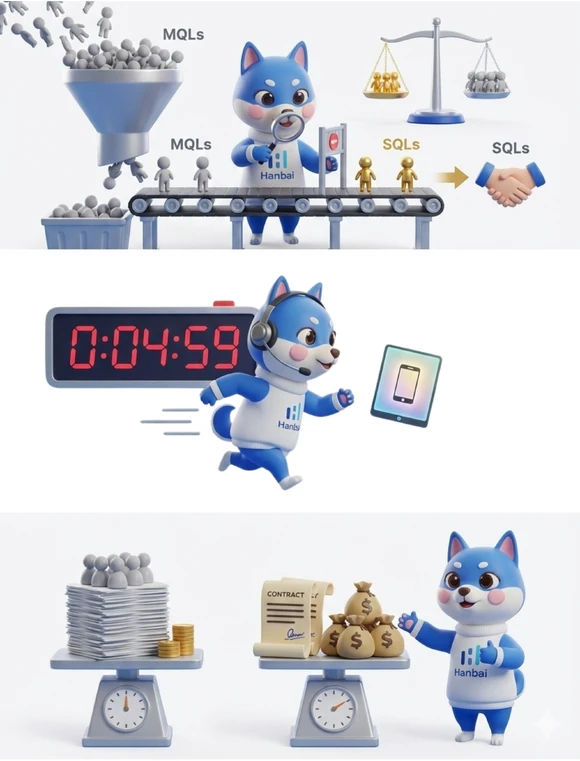
1. Top-of-Funnel KPIs: measuring fuel quality
The top of the funnel (ToFu) is about attraction. Here the common mistake is to obsess over quantity. The true B2B sales expert obsesses over quality.
-
MQL to SQL conversion rate:
This is the metric of truth between Marketing and Sales. It measures what percentage of Marketing Qualified Leads (interested parties) are accepted by sales as Sales Qualified Leads (real opportunities).
Why it matters: If this rate is low, Marketing is attracting the wrong people or Sales is being too demanding. It is the number one friction detector. -
Lead response time (Speed to Lead):
In digital sales, speed is life. Statistics indicate that the probability of contacting a lead drops drastically after the first 5 minutes.
The reality: Every hour of delay is not a delay; it is a sale given away to the competition. -
Cost per Lead (CPL) vs. CAC:
The CPL tells you how much it costs to get a contact. But the CAC (Customer Acquisition Cost) tells you how much it costs to get a contract. A low CPL is useless if those leads never buy.
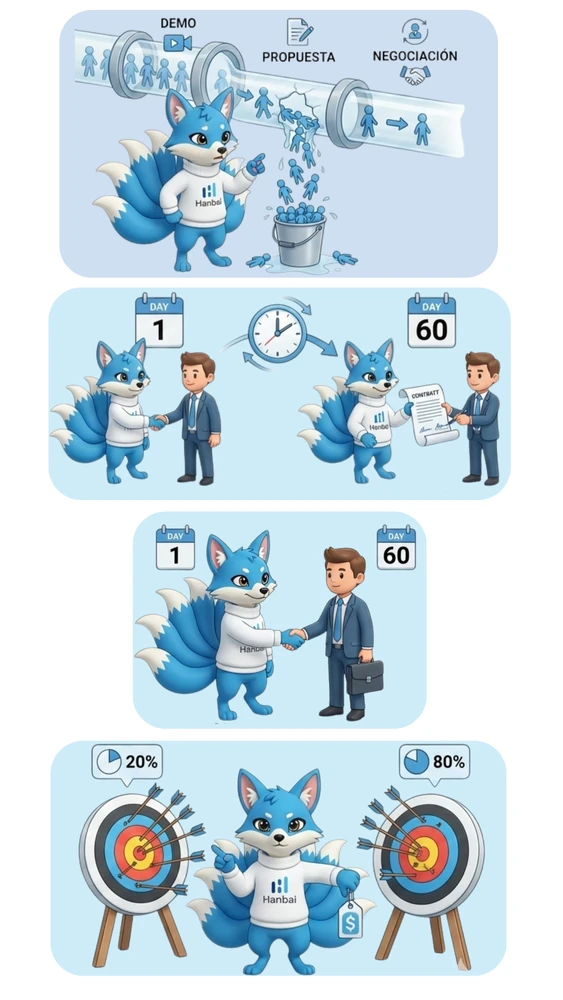
2. Mid & Bottom Funnel KPIs: the health of the pipeline
Once the lead enters the sales process, we need to know if it flows or gets stuck. This is where profitability is won or lost.
-
Stage conversion rate:
Imagine your process as a pipeline. Where is the leak? This KPI tells you what percentage of opportunities move from "Demo" to "Negotiation," or from "Negotiation" to "Close."
Expert diagnosis: If many fall in the proposal phase, perhaps your pricing is off the market or you don't know how to communicate value. -
Sales Cycle Length:
How long does it take from the first "hello" to the contract signing?
The goal: A short sales cycle frees up resources. If your average cycle goes from 30 to 60 days, your sales cost doubles and your revenue forecast breaks. -
Win Rate:
The ultimate KPI. Out of every 10 qualified opportunities, how many do you win?
Benchmark: In B2B, a healthy win rate is usually between 20% and 30%. If it's very low, your team doesn't know how to close. If it's too high (e.g., 80%), you're probably not prospecting enough or your prices are too low.
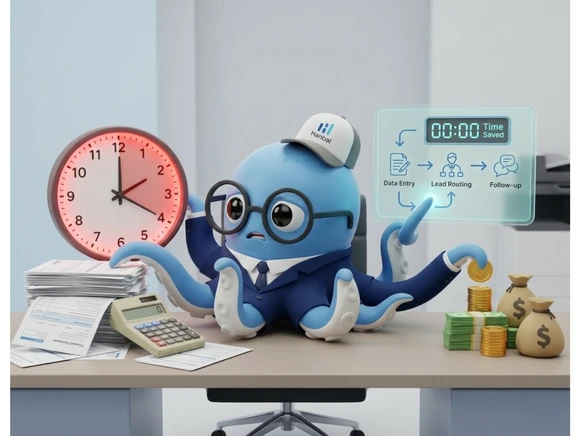 3. Operational KPIs of RevOps: engine efficiency
This is where modern companies differentiate from traditional ones. RevOps (Revenue Operations) introduces metrics that measure system efficiency, not just the bottom line.
-
Forecast Accuracy:
How similar is what you said you would sell to what you actually sold?
Why it is vital: A CEO cannot make investment or hiring decisions if the commercial forecast fails more than a fairground shotgun. RevOps seeks to reduce variance to provide financial security. -
Task automation percentage:
How much time do your salespeople spend selling vs. doing administrative tasks?
The goal: Automate data entry, basic follow-ups, and lead routing. The higher this percentage, the more profitable your human team is.
Data tells a story
The commercial KPIs are not cold numbers on a dashboard; they are the clinical history of your company. They tell you if your value proposition resonates (Top of Funnel), if your team knows how to defend the price (Win Rate), and if your business is predictable (Forecast).
Don't try to measure everything tomorrow. Start with these key indicators and transform intuition into science.
Do your current KPIs allow you to predict your future or just tell you what has already happened?