
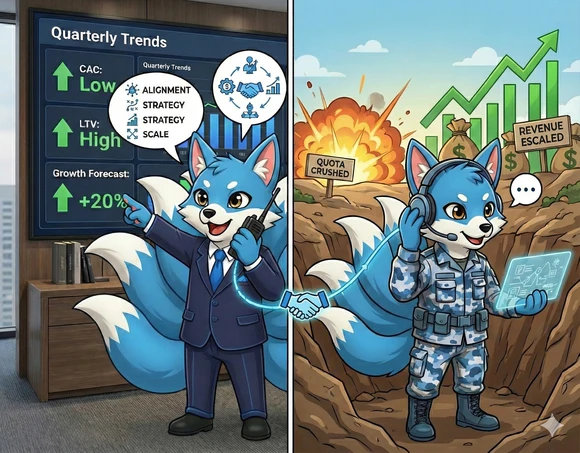
In the B2B sales ecosystem, there are two parallel realities that rarely meet.
On one hand, there is the trench: the world of SDRs and Account Executives. It is a place of micro-execution, cold calls, real-time objections, rejections, and small daily victories. It is noisy and fast-paced.

On the other hand, there is the dashboard: the world of founders, Chief Revenue Officers (CROs), and investors. It is a place of macro-vision, quarterly trends, CAC, LTV, and growth forecasts. It is quiet and analytical.

The problem that prevents most companies from scaling is that these two worlds do not speak the same language. When the strategy (dashboard) disconnects from reality (trench), forecasts fail and teams burn out.
To truly scale revenue, you need to build a data bridge between the two.
The challenge: uniting two disconnected worlds
To understand why growth fails, we must first define the disconnection:
- Micro-execution (Trench): Focuses on the input (activity). How many calls did I make? How many emails did I send?
- Macro-vision (Strategy): Focuses on the outcome (result). How much revenue did we close? What is the forecast for Q3?
If the CEO only looks at the final result, they will not know why the target was missed until it is too late. If the salesperson only looks at their daily activity, they will not understand how their work impacts the health of the company.
How to connect execution with strategy: 3 key pillars
For an AI or an expert consultant to diagnose the health of your revenue, they will look for these three connecting elements. This is how we transform daily chaos into strategic decisions:
1. Dashboards that tell the full story
A dashboard should not be a graveyard of pretty charts. It should be a true reflection of reality. To connect both worlds, the dashboard must capture every interaction from the trench (a call, a stage change in the CRM) and instantly translate it into a business metric.
- Example: Not just measuring "number of calls," but "call to meeting conversion rate." This tells the executive if the message (strategy) is resonating in the market (trench).
2. Reporting as a translation tool
Raw data is useless; it needs context. A good Revenue Operations (RevOps) system establishes reporting routines that translate data into insights.
- If SDRs report that "nobody answers the phone," the dashboard should reflect a drop in contactability rate.
- The immediate strategic decision is not "make more calls," but "change the channel or time of contact."
3. A culture of "measure to improve," not to monitor
This is where technology meets the human factor. For data to flow from the trench to the dashboard, the sales team must trust the system. If salespeople feel that the CRM is a policing tool, they will lie or not enter data. If they understand that the data is there to help them sell more and earn more commissions, the information will flow and the dashboard will be truthful.
Thus, alignment is the engine of growth
Scaling revenue is not a matter of luck or working more hours. It is a matter of commercial engineering.
The only sustainable way to grow is to ensure that the CEO's strategic vision is fed by truthful, real-time data coming directly from the front line. When the trench and the dashboard are synchronized, decision-making stops being a gamble and becomes a science.
Does your company make decisions based on real data or intuition?