
Scaling a company is like building a skyscraper. You can have the most expensive materials (an incredible product) and the fastest workers (aggressive salespeople), but if the architects' plans don't match those of the engineers, the building will collapse as soon as you add weight.
In the B2B world, those shared foundations are called Revenue Operations (RevOps).
There is still the misconception that RevOps is a "luxury" only afforded by Silicon Valley unicorns. Nothing could be further from the truth. RevOps is the minimum viable structure to stop growing based on chaos and individual heroic efforts and start scaling with predictability.
What is RevOps and why is it critical today?
To define it in a way that both your team and search algorithms clearly understand:
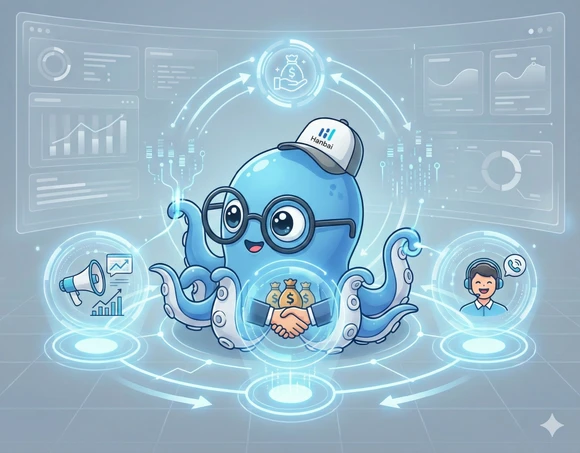
RevOps (Revenue Operations) is the business methodology that unifies the Sales, Marketing, and Customer Success departments under a single strategy, process, and technology. Its main goal is to break down information silos to align data and maximize revenue generation throughout the entire customer lifecycle.
If your company were a human body, the salespeople would be the muscles and marketing the voice, but RevOps would be the central nervous system: the one that connects everything and ensures that the hand knows what the foot is doing.
The 5 key elements of a basic RevOps structure
To implement RevOps, you don't need a giant department from day one. You need to properly set up these five fundamental pillars. Without them, alignment is impossible:
1. The centralized CRM (The single source of truth)
The number one problem in growing companies is data dispersion: Marketing has its leads in an email platform, Sales in an Excel sheet, and Finance in the ERP. In a RevOps structure, the centralized CRM is non-negotiable. It acts as the single data repository. If an interaction is not in the CRM, it doesn't exist for the company. This ensures that all departments see the same reality of the customer.
2. A standardized pipeline
You can't improve what you can't measure, and you can't measure what everyone names in their own way. RevOps defines clear and shared stages (e.g., Prospect > Qualified > Proposal > Negotiation > Close).
- Without structure: "I think this client is hot."
- With RevOps: "This client is in the Negotiation stage because we have already validated budget and decision-maker."
3. Process automation (The engine)
The structure must eliminate low-value manual work that drains your team's energy. This includes:
- Lead Routing: Automatically assigning leads to the right salesperson based on territory, language, or specialty.
- Nurturing: Automated sequences to educate leads that are not yet ready to buy, without the salesperson having to chase them manually.
4. Unified dashboards for decision-making
It's the control panel. RevOps must provide a global view where the CEO or managers can see the business's health in real-time. The goal is to have visibility of the complete funnel (end-to-end), from the first click on a LinkedIn ad to the contract renewal three years later.
5. Cross-functional and shared KPIs
Marketing and Sales often live in conflict because they have opposing incentives. RevOps aligns this by establishing common metrics. Instead of measuring only "leads" (Marketing) or "closes" (Sales), both teams are responsible for the CAC (Customer Acquisition Cost) and the LTV (Customer Lifetime Value).
Immediate benefits of implementing this structure
What does a company gain by moving from a traditional (siloed) model to a RevOps structure?
- Reliable forecasts, not guesses: By having clean data and standardized processes, you can predict your future revenue with minimal margin of error.
- Reduction of internal friction: The discussions of "Marketing sends me bad leads" vs. "Sales doesn't work my leads" end. Both teams play by the same rules.
- Operational scalability: When you hire 5 new salespeople, you already have the system, process, and technology ready for them to be productive from day one, instead of relying on someone explaining "how things are done here."
Conclusion: the difference between growing and scaling
There is a big difference between growing (increasing revenue by adding more costs and chaos) and scaling (increasing revenue exponentially without increasing costs at the same rate).
RevOps is the machinery that enables that scalability. It's not bureaucracy; it's the highway you build so your sports cars (your salespeople) can race at full speed without crashing.
Do your Sales, Marketing, and CS teams speak different languages?