There was a moment, back in 2020, when we thought the office was dead. We promised ourselves that working in pajamas from the sofa was the pinnacle of labor evolution. However, three years later, data and feelings tell a different story. We are beginning to see the cracks of digital loneliness. The fatigue of the ‘total remote’ model is a reality that is silently affecting startup culture and, more critically, the development of young talent.
Don’t get me wrong, no one wants to clock in from 9 to 6 in a gray office. But at Hanbai, we’ve detected that both CEOs and employees are looking for something that was lost in the digital transition: spontaneous human connection. The debate is no longer "home vs. office," but how to design an ecosystem where flexibility does not mean isolation.
What is the fatigue of the total remote model and how does it affect us?
The fatigue of the total remote model is not fatigue from working; it’s fatigue from disconnecting. It’s the feeling that your company is just a URL and a Slack account. For sales directors and team leaders, this translates into a loss of "cultural glue."
When interaction is limited to scheduled meetings, the magic of the unexpected is lost: that idea that arises at the coffee machine or that doubt that is resolved perhaps by turning the chair.
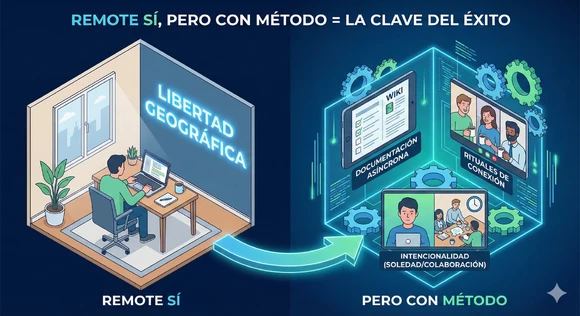
Remote yes, but with method = the key to success
Telecommuting is a fantastic tool, but like any tool, it needs instructions. Our mantra is clear: remote yes, but with method.
The mistake was thinking that “remote” meant "leaving people alone." For it to work, geographic freedom must be accompanied by a clear communication structure.
- Asynchronous documentation: If it’s not written, it doesn’t exist.
- Connection rituals: Informal digital spaces that are not for reporting, but for connecting.
- Intentionality: Deciding which tasks require solitude and which require collaboration (Brainstorming).
"Remote work without structure is just decentralized chaos. The companies that win today are not those that eliminate the office, but those that give a clear purpose to each environment: home for concentration, office for collaboration." — Elisa Aguilera Head of talent at Hanbai.
The hidden cost: why juniors learn more with a team nearby
This is perhaps the most painful point for the SaaS and sales sector. Sales is a craft of oral transmission and observation. There is a biological and professional reason that explains why juniors learn more with a team nearby: osmosis.
Imagine a junior SDR (Sales Development Representative) at home. They make a call, get hung up on, and get frustrated alone. Now imagine them in the office. They make the call, get hung up on, and the Senior Account Executive next to them laughs, tells them how the same thing happened to them yesterday, and gives them a 30-second tip that changes their day.
That informal learning, that "listening to how the person next to you closes a deal," is impossible to replicate on Zoom.
- Immediate feedback: Real-time correction accelerates the learning curve by 50%.
- Behavior modeling: Juniors imitate what they see. If they don’t see anyone working, who do they imitate?
- Belonging: It’s hard to feel loyalty towards a screen; it’s easy to feel it towards a team that invites you to lunch.
Well-done hybrid is not going back
Many employees fear that returning to the office is a trap to regain presencial control. Nothing could be further from the truth. Well-done hybrid is not going back; it’s moving towards a more sophisticated model.
An intelligent hybrid model (for example, 2 or 3 purposeful in-person days) combines the best of both worlds:
- Office days (anchor days): Everyone goes on the same days. Meetings, team dynamics, training, and socialization are prioritized.
- Remote days: Unnecessary internal meetings are prohibited. It’s time to execute, write, and produce without interruptions.
At Hanbai, we help companies implement these policies not as an imposition, but as a performance benefit.
Balance is the new competitive advantage
The fatigue of the ‘total remote’ model is a warning sign, not a death sentence for telecommuting. It’s telling us that, as human beings, we need balance.
The companies that will lead the market will not be 100% in-person or 100% remote, but those that understand the psychology of their teams. It’s about offering an environment where a junior can absorb knowledge by osmosis and a senior can reconcile their family life without friction.
At Hanbai Talent, we don’t just look for candidates; we look for people who fit your culture, whether remote, in-person, or hybrid. But above all, we help you define that culture so that it is a motor of attraction, not of escape.
Is your team suffering from disconnection, or do you not know how to structure your hybrid model?
Don’t scale alone; accelerate with the expert team that already dominates your market.